CariParkir — Smart Parking Finder for Indonesian Cities
Mobile app for finding real-time parking availability with digital booking, cashless payments, and GPS navigation to parking spots across Indonesian cities.
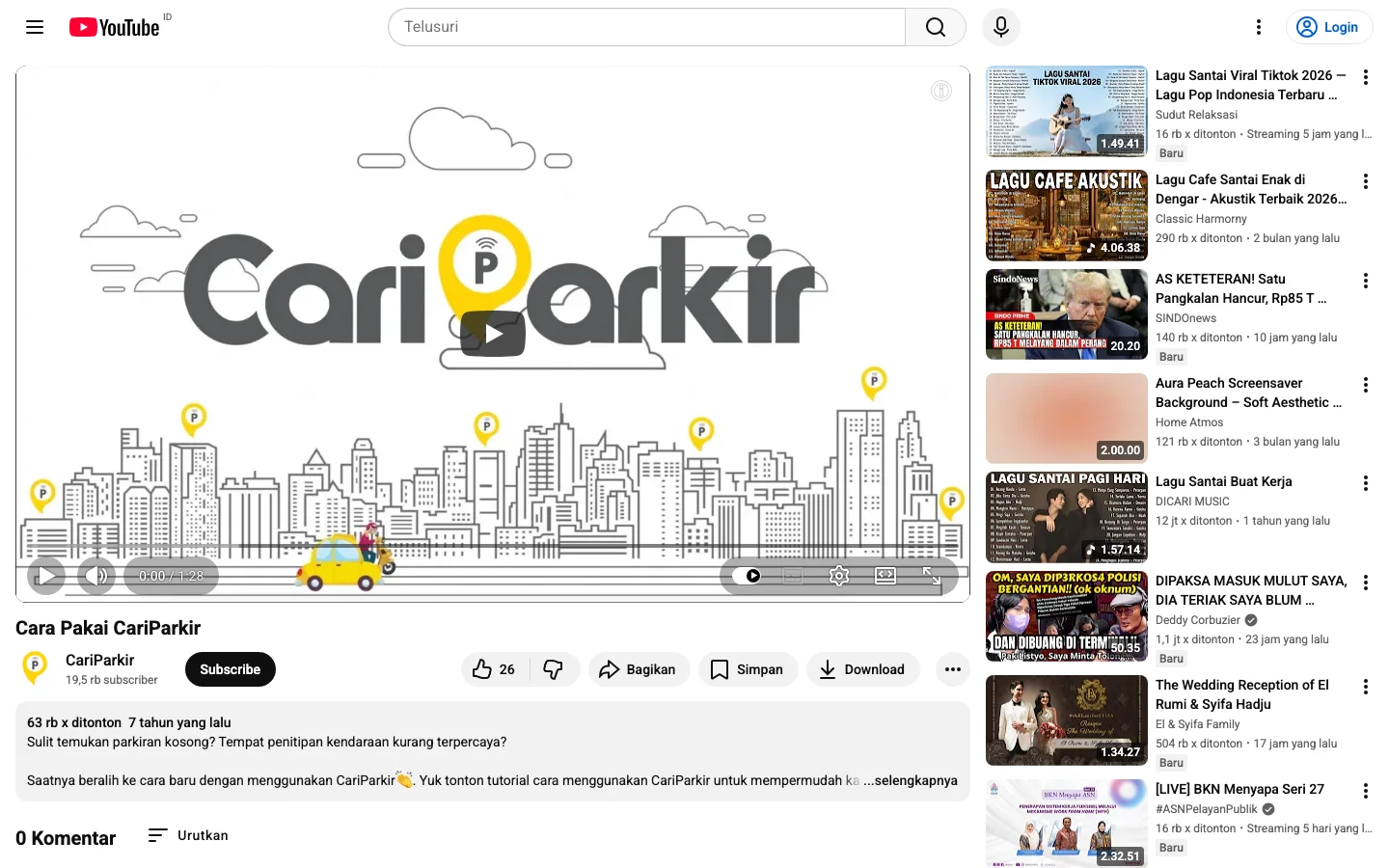
The Problem
Finding parking in Indonesian cities — especially Jakarta — is a daily frustration. Drivers circle blocks for 15-20 minutes looking for available spots, wasting fuel, increasing traffic congestion, and arriving late to appointments. Parking operators rely on manual ticketing with no real-time visibility into available spaces. There’s no way to know if a parking lot has space before you arrive, and no option to reserve a spot in advance.
The Solution
CariParkir is a smart parking app that gives drivers real-time visibility into parking availability across participating lots and buildings. Users can search for nearby parking, check availability and pricing, book spots in advance, and navigate directly to the entrance. Cashless payment eliminates the need for physical tickets and cash at the gate.
Demo
Key Features
Parking Discovery
- Real-time availability — See how many spots are open at each parking location before heading there
- Search by location — Find parking near your destination with map-based search
- Pricing transparency — View hourly rates and total estimated cost upfront
Booking & Payment
- Advance booking — Reserve a parking spot before you arrive
- Cashless payment — Pay digitally through the app, no physical tickets or cash needed
- Parking history — Track past parking sessions with digital receipts
Navigation
- GPS directions — Turn-by-turn navigation from your current location to the parking entrance
- Multiple operators — Coverage across mall parking, commercial buildings, and public facilities
Smart City Integration
- IoT sensors — Real-time data from parking lot sensors for accurate availability
- Operator dashboard — Parking operators manage occupancy, pricing, and revenue through a web dashboard
- Usage analytics — Data on parking utilization patterns helps city planners optimize urban parking infrastructure
What I Learned
- Real-time data requires reliable infrastructure — Parking availability is only useful if it’s accurate. IoT sensors, API latency, and data freshness all affect user trust. Showing “5 spots available” when the lot is full destroys the app’s credibility instantly.
- Parking is a two-sided marketplace — You need both drivers (demand) and parking operators (supply) on board. Early focus on operator onboarding in high-traffic areas creates the supply that attracts drivers.
- Cashless adoption was early-stage — In 2018 Indonesia, digital payments were still gaining traction. Supporting multiple payment methods (e-wallet, bank transfer, cash fallback) was essential for user adoption.
- Navigation to parking entrances is harder than it sounds — GPS gets you to the building, but the parking entrance is often on a different side or basement level. Accurate entrance coordinates — not just building coordinates — are what users actually need.
For another Indonesian mobility project, see my SEJALAN carpooling platform — a different approach to urban transportation through route-based ride sharing and cost splitting.
More Projects
BSpace — Mining Operations and Workforce Management
Flutter mobile app for BUMA mining operations with offline-first task management, GPS telematics, mission tracking, photo validation, and growth dashboards.
DIGIMAN+ — Intelligent Asset Management for Mining
Flutter app for industrial asset management with inspection work orders, approval workflows, maintenance planning, and order management in a Melos monorepo.
SEJALAN — Carpooling & Ride-Sharing Platform for Commuters
Web platform matching drivers and passengers on shared commute routes for cost-sharing. Built with Angular featuring captain registration and promo system.
ERP Platform — Distribution & Retail Business Management
Full-stack ERP for Indonesian distribution with sales, procurement, inventory, accounting, 17+ report types, and multi-branch role-based access control.
More Projects
BSpace — Mining Operations and Workforce Management
Flutter mobile app for BUMA mining operations with offline-first task management, GPS telematics, mission tracking, photo validation, and growth dashboards.
DIGIMAN+ — Intelligent Asset Management for Mining
Flutter app for industrial asset management with inspection work orders, approval workflows, maintenance planning, and order management in a Melos monorepo.
SEJALAN — Carpooling & Ride-Sharing Platform for Commuters
Web platform matching drivers and passengers on shared commute routes for cost-sharing. Built with Angular featuring captain registration and promo system.
ERP Platform — Distribution & Retail Business Management
Full-stack ERP for Indonesian distribution with sales, procurement, inventory, accounting, 17+ report types, and multi-branch role-based access control.
Infonesia FYI — Audio-First Knowledge Sharing Platform
Indonesian paid Q&A platform connecting users with creators and experts through audio responses. Creator economy with payment gateway and Kotlin Android app.
30 Days Web Challenge — Community-Driven Daily Build Experiment
An interactive web experiment where strangers vote on features to build over 30 days, powered by Next.js with real-time voting, animated UI, and daily progress tracking.
Interested in Something Similar?
Need a similar project built, want to collaborate, or have questions about the tech stack? Drop a comment below or reach out directly.