BSpace — Mining Operations and Workforce Management
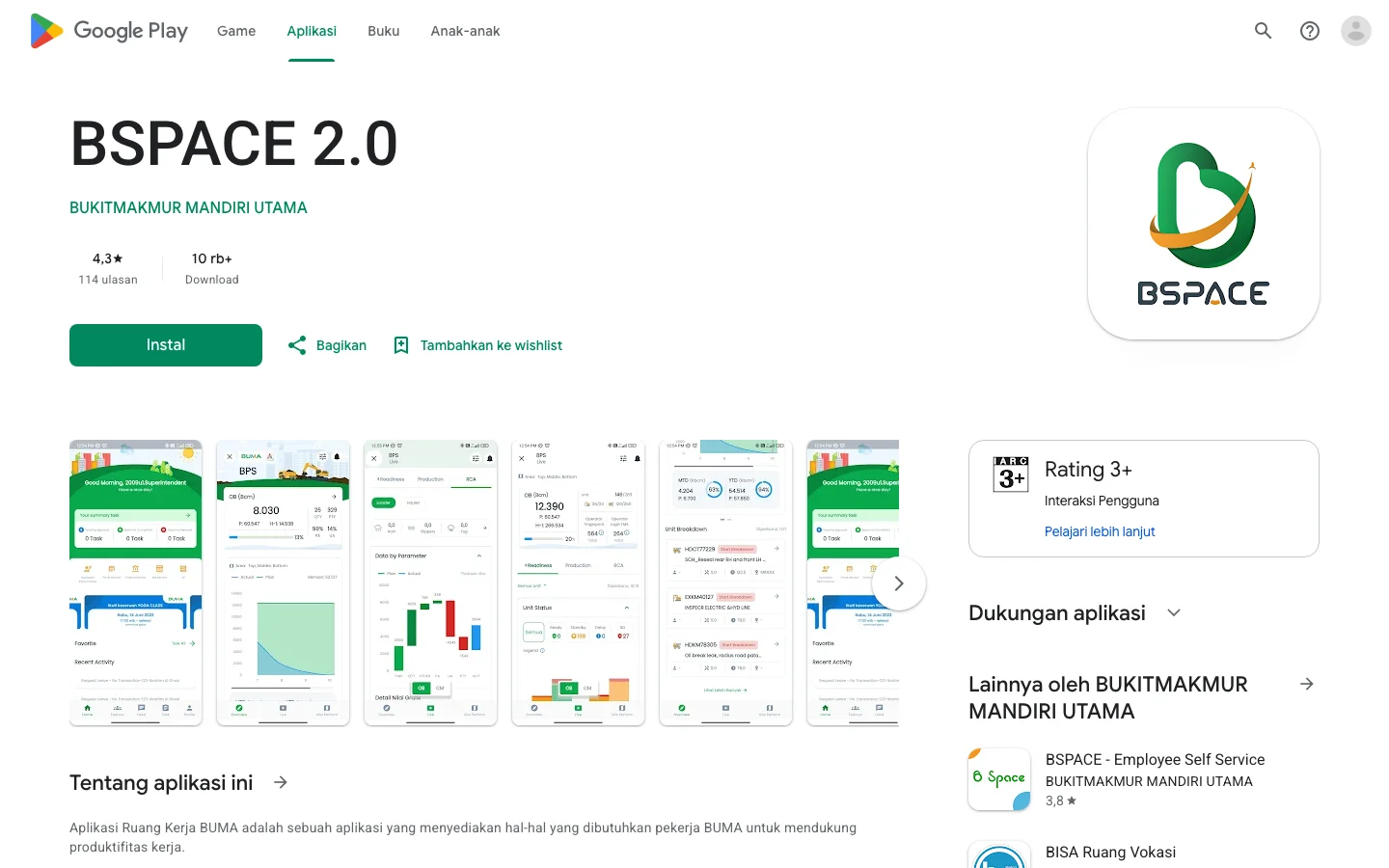
Flutter mobile app for BUMA mining operations with offline-first task management, GPS telematics, mission tracking, photo validation, and growth dashboards.
The Problem
Mining operations at BUMA (Bukit Makmur Mandiri Utama) involve thousands of field workers across remote sites with poor or no internet connectivity. Supervisors need to assign tasks, track mission progress, validate work completion with photo evidence, and monitor workforce growth — all in real-time from HQ. Paper-based processes and WhatsApp groups don’t scale across multiple mining sites, and web-based tools fail when there’s no signal underground or in remote pits.
The Solution
BSpace is a Flutter mobile app designed for BUMA’s mining workforce. It provides offline-first task management, GPS-based telematics, mission tracking with photo validation, and workforce growth dashboards. Workers can complete tasks and submit evidence offline, and everything syncs automatically when connectivity returns. The app integrates with Azure API Management for secure backend communication and Azure AD for enterprise authentication.
Key Features
Task Management
- Task assignment and tracking — Supervisors assign tasks, workers receive and complete them in the field
- Offline-first architecture — Tasks available offline via Isar local database, sync on reconnect
- Status workflow — Pending → In Progress → Completed with timestamps
Mission Tracking
- Active and past missions — View current missions and historical mission records
- Mission detail views — Deep-dive into individual missions with progress tracking
- Validation system — Photo evidence submission for task completion verification
Telematics & GPS
- Location tracking — GPS-based location monitoring for field workers
- Background location service — Continuous tracking even when app is minimized
- Geofencing support — Location-aware features tied to mining site boundaries
Growth & Analytics
- Workforce growth dashboards — Visual performance metrics with Syncfusion charts
- Rating system — Worker performance ratings and evaluations
- Overview analytics — High-level operational metrics for supervisors
Enterprise Integration
- Azure AD authentication — Enterprise single sign-on via Azure Active Directory
- Azure API Management — Secure, rate-limited API gateway for backend services
- CI/CD via Azure DevOps — Automated builds, testing, and distribution
- Multi-environment support — Dev, UAT, and Production environments with separate configurations
What I Learned
- Offline-first is a mindset, not a feature — Designing for intermittent connectivity affects every layer: data storage (Isar/Hive), sync logic, UI states (loading/synced/conflict), and error handling. It’s not something you bolt on later.
- Enterprise mobile is different from consumer mobile — Azure AD auth, API gateways, role-based access, audit trails, and multi-environment deployments add significant complexity that consumer apps never deal with.
- GPS in mining sites is unreliable — Underground pits, heavy machinery, and remote locations mean GPS accuracy varies wildly. Fallback strategies and graceful degradation are essential.
- Flutter handles complex enterprise UIs well — Syncfusion charts, data grids, image cropping, QR scanning, and background services all work reliably in a single Flutter codebase across Android and iOS.
For another look at enterprise Flutter development with offline-first architecture, check out my DIGIMAN+ asset management app — built as a Melos monorepo with Isar and Azure AD.
More Projects
30 Days Web Challenge — Community-Driven Daily Build Experiment
An interactive web experiment where strangers vote on features to build over 30 days, powered by Next.js with real-time voting, animated UI, and daily progress tracking.
CSSKit — Open-Source CSS Animation Library with 310+ Animations
A free, open-source CSS animation library built with Astro and React. Browse 310+ animations across 11 categories, customize parameters live, and copy-paste into your project. Zero dependencies.
Event Photo Platform — OCR Bib Number Detection System
Full-stack monorepo with dual OCR providers, async BullMQ job processing, S3 storage, and real-time bib number search for race event photography platforms.
Festival Jamu Nusantara — Event & QR Check-in Platform
Full-stack event platform for Indonesian jamu festival with QR check-in, member points, gallery system, and Filament admin panel. Built with Next.js and Laravel.
More Projects
30 Days Web Challenge — Community-Driven Daily Build Experiment
An interactive web experiment where strangers vote on features to build over 30 days, powered by Next.js with real-time voting, animated UI, and daily progress tracking.
CSSKit — Open-Source CSS Animation Library with 310+ Animations
A free, open-source CSS animation library built with Astro and React. Browse 310+ animations across 11 categories, customize parameters live, and copy-paste into your project. Zero dependencies.
Event Photo Platform — OCR Bib Number Detection System
Full-stack monorepo with dual OCR providers, async BullMQ job processing, S3 storage, and real-time bib number search for race event photography platforms.
Festival Jamu Nusantara — Event & QR Check-in Platform
Full-stack event platform for Indonesian jamu festival with QR check-in, member points, gallery system, and Filament admin panel. Built with Next.js and Laravel.
Engineering Ladders Picker — Career Level Assessment Tool
A web-based Engineering Ladders assessment tool that helps engineers pick axis levels, compare against reference ladders, and export a clean PDF summary.
Semesa Grande — Residential Community Management App
Full-stack PWA with role-based dashboards, kas payment tracking, audit workflows, asset borrowing, document management, and push notifications for communities.
Interested in Something Similar?
Need a similar project built, want to collaborate, or have questions about the tech stack? Drop a comment below or reach out directly.